

Introduction
Speculative Decoding AI Artificial intelligence has made remarkable progress in recent years, but one challenge still remains—speed. Whether you’re asking an AI assistant to write an article, generate code, or summarize a report, every response requires complex calculations that can take time, especially for large language models (LLMs).
To solve this problem, AI researchers developed an advanced technique called Speculative Decoding. This method helps AI models generate responses much faster without significantly reducing accuracy. As companies continue building more powerful AI systems, speculative decoding is becoming one of the most important optimization techniques in modern artificial intelligence.
In this beginner-friendly guide, you’ll learn what speculative decoding is, how it works, why it matters, and why it is becoming a key technology behind faster AI assistants in 2026.
Quick Bio Table
| Attribute | Details |
|---|---|
| Technology Name | Speculative Decoding |
| Category | Artificial Intelligence |
| Type | AI Inference Optimization Technique |
| Primary Purpose | Speed up Large Language Model (LLM) text generation |
| Works With | Large Language Models (LLMs) |
| Main Components | Draft Model, Target Model, Token Verification |
| Key Benefits | Faster responses, reduced latency, lower GPU usage, cost savings |
| Common Applications | AI Chatbots, Coding Assistants, Writing Tools, Search Engines |
| Target Users | Developers, Businesses, Researchers, AI Enthusiasts |
| Difficulty Level | Beginner to Intermediate |
| Introduced | Modern AI research (widely adopted in the 2020s) |
| Future Outlook | Expected to become a standard optimization technique for AI models |
What Is Speculative Decoding?
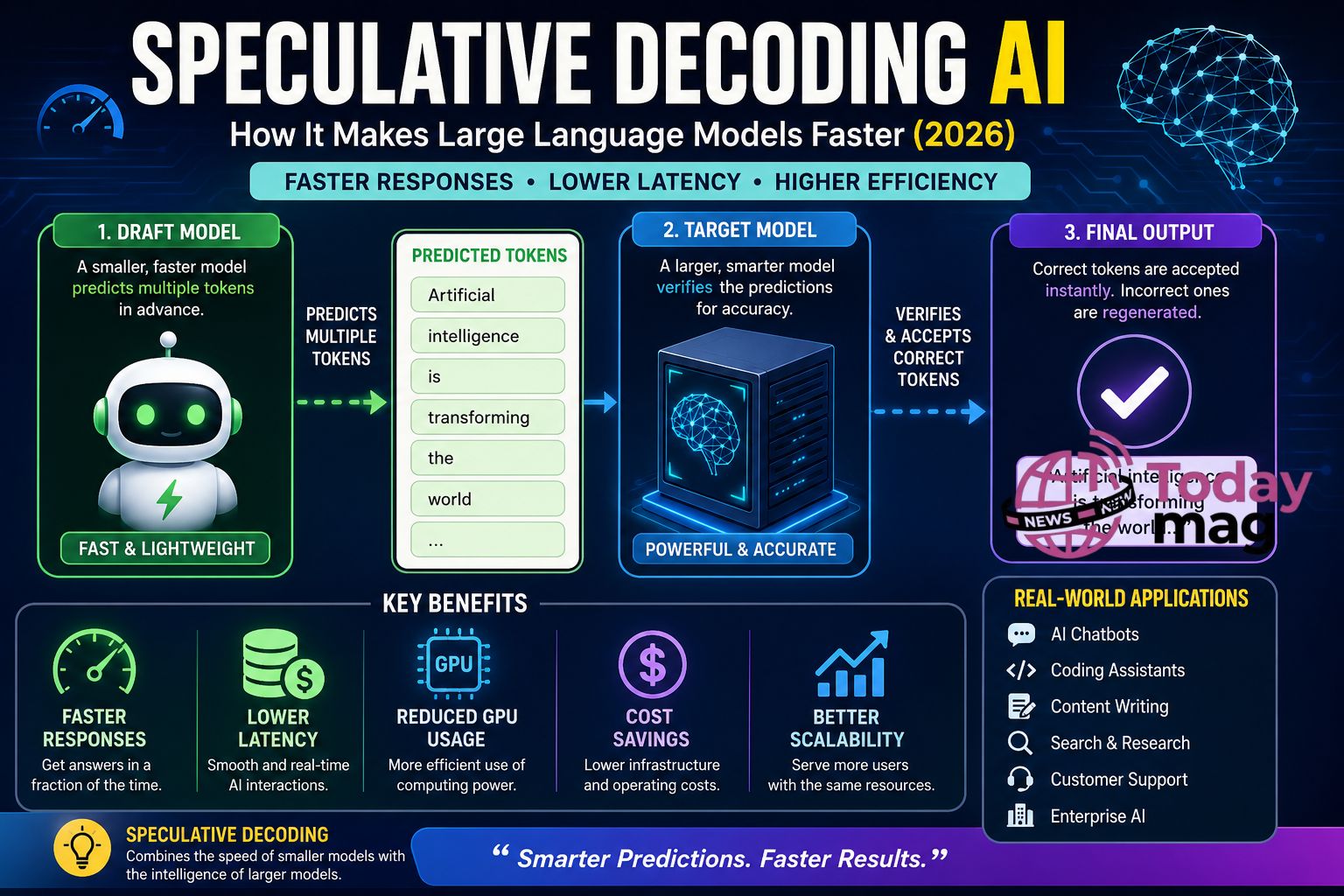
Speculative Decoding is an AI optimization technique that speeds up text generation by allowing a smaller, faster model to predict multiple words (or tokens) in advance while a larger AI model verifies those predictions.
Instead of generating one token at a time, speculative decoding lets AI “guess ahead,” reducing waiting time and improving overall performance.
Think of it like this:
Imagine a teacher checking homework.
- A student completes several questions quickly.
- The teacher reviews them all at once.
- If the answers are correct, they are accepted.
- If some are wrong, only those need correction.
Speculative decoding works in a similar way. A lightweight AI model predicts upcoming tokens, and the larger model confirms whether those predictions are correct.
Why Was Speculative Decoding Created?
Large language models are extremely powerful, but they require significant computing resources.
Normally, AI generates text using this process:
- Predict one token.
- Verify it.
- Predict the next token.
- Repeat until the response is complete.
Although accurate, this process becomes slower as models grow larger.
Researchers introduced speculative decoding to reduce unnecessary computations while maintaining high-quality output.
The result is:
- Faster responses
- Lower latency
- Better user experience
- Reduced GPU workload
- Improved efficiency
How Does Speculative Decoding Work?
The process involves two AI models working together.
Step 1: Draft Model
A small and fast model predicts several future tokens.
Example:
Instead of predicting:
Artificial →
It predicts:
Artificial intelligence is transforming modern businesses.
Step 2: Verification Model
A larger language model checks whether those predictions are correct.
If they match what the larger model would have generated, all predicted tokens are accepted instantly.
If some predictions are incorrect, the larger model simply regenerates those parts.
This verification process allows AI to generate text much faster than traditional decoding.
Simple Example
Without speculative decoding:
AI writes:
- Hello
- my
- name
- is
- ChatGPT
Each word requires a separate prediction.
With speculative decoding:
The smaller model predicts:
Hello my name is ChatGPT
The larger model verifies the entire sequence.
If everything is correct, all words are accepted together, saving valuable processing time.
Key Components of Speculative Decoding

Understanding the main components makes this technique much easier to grasp.
Draft Model
A lightweight language model responsible for making fast predictions.
Its job is speed rather than perfect accuracy.
Target Model
The larger, more powerful AI model.
It validates the draft model’s predictions before they become part of the final response.
Token Verification
Each predicted token is checked efficiently.
Correct predictions are accepted immediately.
Incorrect predictions are regenerated by the target model.
Acceptance Mechanism
The verification system decides which predicted tokens are accepted and which require correction.
This balance helps maintain both speed and quality.
Benefits of Speculative Decoding
This technique provides several major advantages for AI systems.
Faster Responses
Users receive answers more quickly.
Lower Latency
AI assistants feel more responsive during conversations.
Reduced Computing Costs
Less GPU processing means lower infrastructure expenses.
Better Scalability
Cloud AI services can handle more users simultaneously.
Improved User Experience
Faster responses create smoother interactions for writing, coding, research, and customer support.
Where Is Speculative Decoding Used?
Today, speculative decoding is becoming increasingly common across AI applications.
Popular use cases include:
- AI chatbots
- Coding assistants
- Writing assistants
- Search engines
- Customer support systems
- Enterprise AI platforms
- Research assistants
- Document summarization tools
As AI models continue growing in size, speculative decoding is expected to become a standard optimization technique across the industry.
Why It Matters in 2026
AI users now expect instant responses, even from models containing hundreds of billions of parameters.
Without performance optimization, these advanced models would become slower and more expensive to operate.
Speculative decoding helps solve this challenge by combining the speed of smaller models with the intelligence of larger ones, making AI systems faster, more efficient, and more practical for real-world applications.
Speculative Decoding vs Traditional Decoding
To understand why speculative decoding is important, let’s compare it with the traditional decoding process used in many AI models.
| Feature | Traditional Decoding | Speculative Decoding |
|---|---|---|
| Token Generation | One token at a time | Multiple tokens predicted together |
| Speed | Slower | Much faster |
| GPU Usage | Higher | Lower |
| User Experience | More waiting | Faster responses |
| Cost | Higher infrastructure cost | More cost-efficient |
| Best For | Smaller AI models | Large Language Models (LLMs) |
The biggest advantage is that speculative decoding improves speed without noticeably reducing the quality of AI-generated text.
Technical Workflow of Speculative Decoding
Although the concept sounds advanced, the workflow is straightforward.
Step 1: User Sends a Prompt
For example:
“Write a short article about renewable energy.”
Step 2: Draft Model Predicts
A smaller AI model quickly predicts the next several tokens instead of generating only one.
Example:
Renewable energy is becoming one of…
Step 3: Target Model Verifies
The larger language model checks whether those predicted tokens match what it would have generated.
If they are correct, the entire sequence is accepted instantly.
Step 4: Incorrect Tokens Are Fixed
If the draft model makes a mistake, the target model regenerates only the incorrect portion.
This keeps accuracy high while still saving processing time.
Step 5: Final Response Appears
The verified text is returned to the user much faster than with traditional decoding.
Real-World Applications
Speculative decoding is already helping improve the performance of many AI-powered services.
AI Chatbots
Modern AI assistants can answer questions more quickly while reducing server load.
Code Generation
Programming assistants generate code suggestions with lower latency, improving developer productivity.
Content Writing
AI writing tools can produce long-form articles, blog posts, and reports more efficiently.
Customer Support
Businesses can serve more customers simultaneously without increasing hardware requirements.
Search and Research
AI-powered search systems summarize documents and answer complex questions more quickly.
Enterprise AI
Organizations using AI for internal workflows benefit from faster document analysis and task automation.
Advantages of Speculative Decoding
This technology offers several important benefits.
Faster AI Responses
Users spend less time waiting for generated content.
Better Hardware Efficiency
GPUs perform fewer expensive calculations, reducing computational overhead.
Lower Operating Costs
Cloud providers can process more requests using the same infrastructure.
Improved Scalability
AI services can support more users without sacrificing performance.
Enhanced User Experience
Whether writing emails, generating code, or answering questions, faster responses make AI feel more natural and responsive.
Limitations of Speculative Decoding
Despite its advantages, speculative decoding is not perfect.
Prediction Errors
If the draft model predicts many incorrect tokens, the larger model must regenerate them, reducing speed gains.
Additional Complexity
Running two coordinated models requires careful engineering and optimization.
Model Compatibility
Not every AI architecture supports speculative decoding equally well.
Hardware Considerations
The performance improvements depend on the available hardware and implementation quality.
How Leading AI Companies Use It
Many organizations developing advanced language models are exploring or implementing speculative decoding to improve performance.
The technology is especially valuable for:
- Large Language Models (LLMs)
- AI coding assistants
- Enterprise AI platforms
- Cloud AI services
- High-volume chatbot systems
As AI adoption continues to grow, techniques like speculative decoding help deliver faster responses while keeping computing costs under control.
Common Misconceptions
“Speculative Decoding Changes the AI’s Knowledge”
False.
It only changes how quickly the AI generates responses, not what the AI knows.
“It Reduces Accuracy”
Not necessarily.
The larger verification model checks the predictions before they are shown to the user, helping maintain output quality.
“Only Developers Benefit”
Incorrect.
Anyone using AI—writers, students, researchers, businesses, or developers—benefits from faster and smoother responses, even if they never see the technology working behind the scenes.
Why Businesses Should Care
For companies deploying AI at scale, response speed directly affects user satisfaction and operational costs.
By reducing latency and improving efficiency, speculative decoding allows businesses to:
- Deliver faster customer experiences
- Handle higher traffic volumes
- Reduce cloud computing expenses
- Scale AI services more effectively
- Improve productivity across teams
These advantages make speculative decoding one of the most impactful optimization techniques in modern AI infrastructure.
Frequently Asked Questions (FAQs)
What is Speculative Decoding in AI?
Speculative Decoding is an optimization technique that allows a smaller AI model to predict multiple tokens in advance while a larger language model verifies those predictions. This significantly speeds up text generation without greatly affecting accuracy.
Why is Speculative Decoding important?
It helps reduce response time, lowers computing costs, and improves the overall performance of large language models (LLMs). This makes AI assistants faster and more efficient for both individuals and businesses.
Does Speculative Decoding reduce accuracy?
No. The larger verification model checks the smaller model’s predictions before they are returned to the user. Incorrect predictions are regenerated, helping maintain high-quality outputs.
Is Speculative Decoding used only in ChatGPT?
No. It is a general AI optimization technique that can be used by many companies building large language models, AI assistants, coding tools, and enterprise AI platforms.
Which industries benefit from Speculative Decoding?
Many industries can benefit, including:
- Software development
- Education
- Healthcare
- Customer support
- Finance
- Marketing
- Research
- E-commerce
Is Speculative Decoding the future of AI?
While it is not the only optimization method, it has become one of the most effective techniques for improving the speed and efficiency of modern AI systems.
Best Practices When Using AI Systems
Although speculative decoding works behind the scenes, users can still improve AI performance by following a few simple practices:
- Write clear and specific prompts.
- Break complex tasks into smaller steps.
- Verify important information before making decisions.
- Use updated AI tools that include the latest optimizations.
- Keep conversations focused for better results.
These habits help AI deliver more accurate and useful responses.
The Future of Speculative Decoding
As AI models continue to grow in size and capability, response speed will remain a major challenge. Researchers are actively improving speculative decoding to make AI even faster and more efficient.
Future developments may include:
- Smarter draft models with higher prediction accuracy.
- Better hardware optimization for GPUs and AI accelerators.
- Lower energy consumption during inference.
- Faster real-time AI assistants.
- Improved support for multimodal AI systems that process text, images, audio, and video.
Experts believe speculative decoding will become a standard feature in next-generation AI platforms, enabling faster and more cost-effective AI services worldwide.
Final Thoughts
Speculative Decoding is one of the most exciting advancements in AI performance optimization. Instead of generating text one token at a time, it allows a lightweight draft model to predict multiple tokens while a larger model verifies them. This simple yet powerful approach reduces latency, lowers computing costs, and creates a smoother user experience.
Whether you’re an AI enthusiast, developer, student, or business owner, understanding speculative decoding provides valuable insight into how modern AI systems deliver fast and reliable responses.
As artificial intelligence continues to evolve, technologies like speculative decoding will play a key role in making AI smarter, faster, and more accessible than ever before.
