

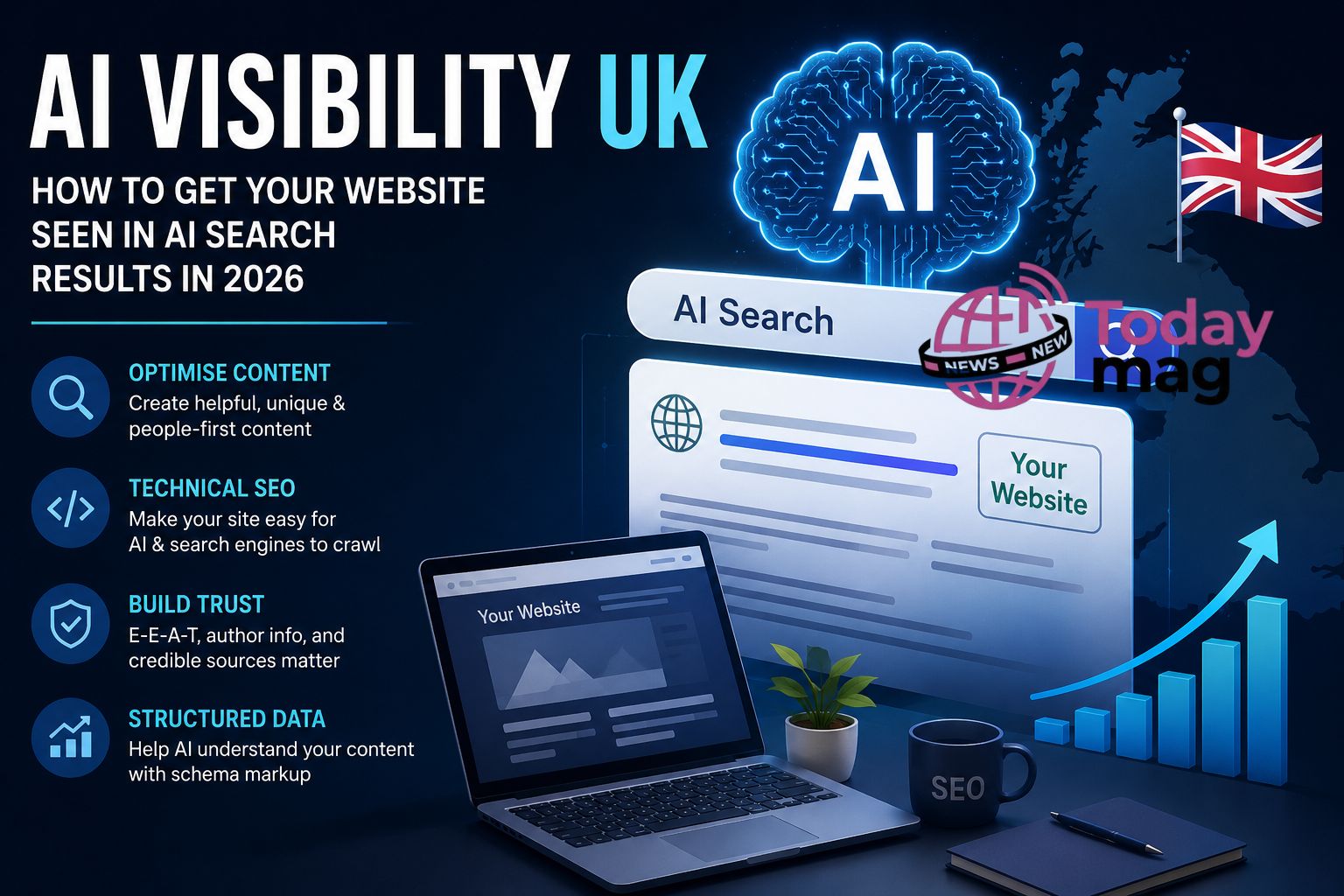
Why AI Visibility Is Becoming the New SEO Opportunity
Search is changing.
For years, website owners focused on one main question: “How do I get my website to rank on Google?” In 2026, there is another question worth asking:
“Can AI-powered search systems discover, understand and recommend my content?”
This is where AI Visibility UK comes into the picture.
AI-powered search experiences such as Google AI Overviews and AI Mode are changing how people find information online. Instead of simply receiving a list of blue links, users can increasingly receive an AI-generated answer that brings information from multiple sources together.
Google itself now provides guidance specifically for website owners who want their content to perform well in its generative AI search features. Importantly, Google says that traditional SEO best practices still matter because these AI features rely on Google’s existing search ranking and quality systems.
Quick Bio
| Field | Details |
|---|---|
| Article Title | AI Visibility UK: How to Get Your Website Seen in AI Search Results in 2026 |
| Focus Keyword | AI Visibility UK |
| Secondary Keywords | AI search UK, AI SEO UK, AI visibility, AI search results, Google AI search |
| Category | Technology / SEO |
| Content Type | SEO Guide |
| Target Audience | UK website owners, bloggers, publishers, businesses and SEO professionals |
| Year | 2026 |
| Recommended Slug | ai-visibility-uk |
| SEO Intent | Informational |
| Featured Image Alt Text | AI Visibility UK – How to Get Your Website Seen in AI Search Results |
| Image Title | AI Visibility UK 2026 |
| Tags | AI Visibility UK, AI SEO, AI Search, SEO UK, Google AI, Search Engine Optimisation, Digital Marketing |
What Does AI Visibility Actually Mean?
AI visibility is the ability of a website, brand or publisher to appear in AI-generated search experiences or be recognised as a useful source when AI systems answer users’ questions.
Imagine someone searches:
“What are the best ways to improve a small UK business website?”
Traditional SEO aims to get your article onto the Google results page.
AI visibility goes one step further: you want your website to be understood as a credible source that an AI-powered search experience could use when generating its response.
This does not mean simply adding the words “AI” or “GEO” throughout an article. Google specifically warns that the fundamentals of creating useful, original content remain important.
Why UK Websites Should Pay Attention
The opportunity is particularly interesting for UK publishers, bloggers, local businesses and online brands.
Google’s documentation shows that AI Overviews and AI Mode are continuing to evolve, while its Preferred Sources feature can allow users to select publications they want to see more prominently. Google has also expanded this functionality to AI Overviews and AI Mode.
That creates a new visibility layer for websites.
A page doesn’t necessarily have to be the traditional number-one result for every query to have value. It needs to provide clear, useful and trustworthy information that search systems can understand.
The Biggest Mistake: Writing Only for Algorithms
Some website owners are responding to AI search by producing hundreds of generic AI-written articles.
That can be a mistake.
More content does not automatically mean more visibility. Google’s current guidance emphasises valuable, unique and non-commodity content, while continuing to recommend established SEO fundamentals.
A stronger approach is to create content that:
- Answers a real search question
- Provides original information or useful analysis
- Uses clear headings and logical structure
- Demonstrates expertise and credibility
- Links to relevant supporting information
- Keeps important facts accurate and up to date
- Gives readers something more useful than a generic AI summary
AI Visibility Is Not a Replacement for SEO
This is perhaps the most important point.
AI Visibility UK is not about abandoning Google SEO.
It is about making good SEO work harder in a search environment where AI-generated answers are becoming part of the user journey.
Google’s latest guidance confirms that SEO fundamentals remain relevant for generative AI features in Search.
So the strategy for 2026 is simple:
Build a website that works for people first, search engines second, and AI-powered discovery as part of the wider search ecosystem.
AI Visibility UK: How to Get Your Website Seen in AI Search Results in 2026

7 Practical Ways to Improve AI Visibility
Getting noticed in AI-powered search is not about finding a secret trick. The strongest approach is to make your website clear, useful, technically accessible and trustworthy.
Google’s latest guidance continues to emphasise useful, original content and good page experience, while AI-powered Search creates additional opportunities for websites to be discovered.
Here are seven practical areas UK website owners should focus on.
1. Make Your Main Topic Crystal Clear
Your homepage should immediately tell visitors and search systems what your website is about.
Your title tag, H1, introduction and meta description should communicate the same core message instead of sending conflicting signals.
This is particularly important because a 2026 audit of more than 1,400 UK business websites found that 62% described their business differently across their title, H1 and meta description.
For example, if your website provides SEO services in the UK, your main page should clearly communicate that rather than using a vague headline such as:
“Welcome to Our Digital World.”
A clearer heading would be:
“UK SEO Services for Small Businesses and Online Brands.”
2. Create Content That Actually Answers Questions
AI search is designed to help people find answers, so your content should make those answers easy to understand.
Instead of writing an article simply to include a keyword, start with the question your audience is asking.
For example:
Weak approach:
“AI Visibility UK is an important topic for businesses.”
Better approach:
“AI visibility means making your website easier for AI-powered search systems to discover, understand and potentially reference.”
The second version gives the reader useful information immediately.
Google’s current guidance stresses creating unique, non-commodity content rather than producing pages that simply repeat information already available elsewhere.
3. Build Topical Authority
One article rarely establishes strong authority on an entire subject.
If your website is targeting AI Visibility UK, create a connected group of useful articles around the topic.
For example:
- AI Visibility UK
- How AI Search Works
- Google AI Overviews Explained
- AI SEO vs Traditional SEO
- How to Optimise Content for AI Search
- AI Search Visibility Tools
- Common AI SEO Mistakes
- How Businesses Can Measure AI Visibility
These articles can link naturally to one another.
This creates a stronger topical structure and gives both readers and search systems more context about what your website knows.
4. Improve Your Technical SEO
Great content still needs a technically accessible website.
Check that:
- Important pages can be crawled
- Pages load properly
- Mobile users can navigate the site
- Internal links work
- Images have useful alt text
- Canonical tags are configured correctly
- Structured data is accurate
- Important content is available in HTML
A recent UK audit found that 23% of the websites tested were blocking at least one major AI crawler, showing that technical accessibility can be an important part of the AI-search discussion.
5. Use Structured Data Where It Makes Sense
Structured data helps communicate information about a page in a machine-readable format.
Depending on the website, useful Schema.org types may include:
- Article
- Organization
- Person
- LocalBusiness
- Product
- BreadcrumbList
Don’t add schema simply because it is available. The markup should accurately describe the content that users can actually see.
A 2026 UK audit found that 44% of audited websites had no Organization schema, while only 4% had Person schema connecting a named individual to the business.
6. Strengthen Author and Trust Signals
People want to know who created information—and AI systems also benefit from clear identity and context.
Consider adding:
- Author names
- Author bios
- Relevant experience
- Editorial information
- About page
- Contact details
- Privacy policy
- Terms and conditions
- Sources where appropriate
For a news or publishing website, a clear author page can be especially useful.
Don’t invent expertise or credentials. Trust is built through accurate information and transparent authorship.
7. Keep Your Information Consistent
Your website should tell the same basic story everywhere.
Your business name, services, location and key information should not change from one page or platform to another without a good reason.
This matters because AI search systems may encounter information about a brand across multiple sources.
One 2026 UK study found that 77% of audited SME websites were sending confusing signals to AI search platforms.
That doesn’t mean 77% of all UK websites have poor AI visibility—the study itself describes its figures as diagnostic findings from its audited sample rather than a national census. But it does highlight a useful SEO lesson: consistency matters.
The Simple AI Visibility Formula
For a website owner, the strategy can be simplified to:
Clear Identity + Helpful Content + Technical Accessibility + Structured Information + Trust = Stronger AI Visibility Potential
There is no guaranteed formula that forces an AI system to mention a website. Search systems change, and visibility depends on many signals.
But improving these foundations can make your website easier for both people and modern search systems to understand.
AI Visibility UK: How to Get Your Website Seen in AI Search Results in 2026
How to Measure and Improve Your AI Visibility
Creating useful content is only the beginning. The next challenge is understanding whether your website is actually gaining visibility as search increasingly includes AI-generated experiences.
Google’s current guidance confirms that traditional SEO remains important for AI Overviews and AI Mode because these features are built on Google’s existing Search ranking and quality systems.
How Can You Measure AI Visibility?
There is no single universal score that tells you exactly how visible your website is across every AI search system.
Instead, monitor several signals.
1. Check Google Search Console
Google Search Console remains one of the most important tools for monitoring organic search performance.
Google has clarified that AI Overviews are included in Search Console’s Performance reporting, while AI Mode traffic also contributes to overall Search Console totals.
Watch your:
- Impressions
- Clicks
- Average position
- Click-through rate
- Top-performing pages
- Search queries
Look for changes over time rather than expecting immediate results after publishing an article.
2. Search Your Important Topics Yourself
Create a list of your most important questions and search them regularly.
For example:
- What is AI visibility?
- How can UK businesses improve AI visibility?
- How does AI search affect SEO?
- What is AI SEO?
- How do AI Overviews work?
Check whether your website appears in traditional results, AI-generated answers or cited sources.
Keep a simple spreadsheet recording the date, query and result.
3. Look Beyond Rankings
A page ranking highly on Google is useful, but modern search visibility can involve more than a traditional blue link.
Google’s AI search documentation explains that AI Overviews and AI Mode can surface links to supporting websites as part of their responses.
This means your SEO strategy should focus on being useful enough to deserve visibility, rather than obsessing over one ranking position.
Common AI Visibility Mistakes to Avoid
Mistake 1: Chasing Secret AI SEO Tricks
There are plenty of claims online about secret techniques that supposedly guarantee AI citations.
Be careful.
Google’s official guidance says many commonly discussed AEO/GEO techniques are not special requirements for Google Search. Google recommends focusing on established SEO fundamentals and useful content instead.
Mistake 2: Relying on llms.txt as a Ranking Shortcut
One popular idea is that adding an llms.txt file will automatically improve visibility in Google AI Search.
Google’s June 2026 documentation update specifically clarified that llms.txt is not needed for Google Search and does not provide a positive or negative ranking effect.
That doesn’t mean other AI systems cannot use such files; it simply means website owners shouldn’t treat llms.txt as a Google ranking shortcut.
Mistake 3: Publishing Large Amounts of Generic Content
More articles do not automatically equal more traffic.
If ten websites publish almost identical AI-generated articles about the same subject, there is little reason for readers—or search systems—to prefer one over another.
Google’s guidance emphasises valuable, unique and non-commodity content.
Instead of publishing ten weak articles, create fewer pages that provide genuinely useful information.
A Practical AI Visibility Checklist for UK Websites
Before publishing your next article, ask:
- Does the article answer a real search question?
- Is the information accurate and up to date?
- Does the article provide something useful beyond generic information?
- Is the main topic obvious from the title and headings?
- Are internal links connected to relevant pages?
- Can Google crawl and index the page?
- Is the author clearly identified where appropriate?
- Are important facts supported by trustworthy sources?
- Is the page easy to read on mobile?
- Are images properly described with relevant alt text?
- Have you checked the page in Google Search Console?
What AI Visibility Could Mean for UK Publishers
For UK bloggers, publishers, businesses and website owners, AI-powered search represents both a challenge and an opportunity.
The challenge is that users may increasingly receive answers directly within search experiences.
The opportunity is that high-quality websites can still become part of those answers and receive valuable visibility when their content is useful and relevant.
Google’s latest documentation continues to make one point clear: there isn’t a separate magic formula that replaces SEO. The fundamentals—useful content, technical accessibility, strong site structure and good search practices—remain the foundation.
Final Thoughts
AI Visibility UK is not about trying to trick artificial intelligence.
It is about building a website that is easy to discover, easy to understand and genuinely valuable to users.
As AI Overviews and AI Mode continue developing, websites that combine strong SEO fundamentals with original expertise and useful content will be better positioned to compete for visibility across the changing search landscape.
The smartest strategy for 2026 is therefore simple:
Don’t write for AI instead of people. Create content so useful that both people and modern search systems can understand its value.
