

Introduction
For thousands of years, humans have looked to the sky with admiration, watching birds soar effortlessly through the air. Their graceful movements, remarkable endurance, and natural ability to navigate vast distances have inspired generations of scientists, inventors, and engineers. Today, modern technology has created flying robots capable of performing tasks that once seemed impossible. Drones inspect infrastructure, assist in rescue missions, and deliver goods across cities.
This raises an interesting question: when it comes to flight and design, who wins the ultimate contest birds or robots?
The comparison is not simply about speed or intelligence. It is a fascinating look at millions of years of evolution versus decades of engineering innovation. While birds represent nature’s refined solution to flight, robots showcase humanity’s ability to imitate and improve upon natural systems for specific purposes.
In this article, we explore the strengths, weaknesses, and unique characteristics of both birds and robots to understand how they compare in the ongoing battle of flight and design.
| Label | Information |
|---|---|
| Topic | Birds vs Robots |
| Category | Flight and Technology |
| Main Focus | Natural vs Artificial Flight |
| Compared Subjects | Birds and Flying Robots |
| Bird Origin | Natural Evolution |
| Robot Origin | Human Engineering |
| Flight Method | Wings vs Motors |
| Intelligence Type | Natural and Artificial |
| Key Advantage of Birds | Energy Efficiency |
| Key Advantage of Robots | Precision and Control |
| Common Applications | Wildlife and Technology |
| Future Trend | Bird-Inspired Robotics |
| Purpose of Comparison | Understanding Flight Design |
Birds vs Robots: Nature vs Technology
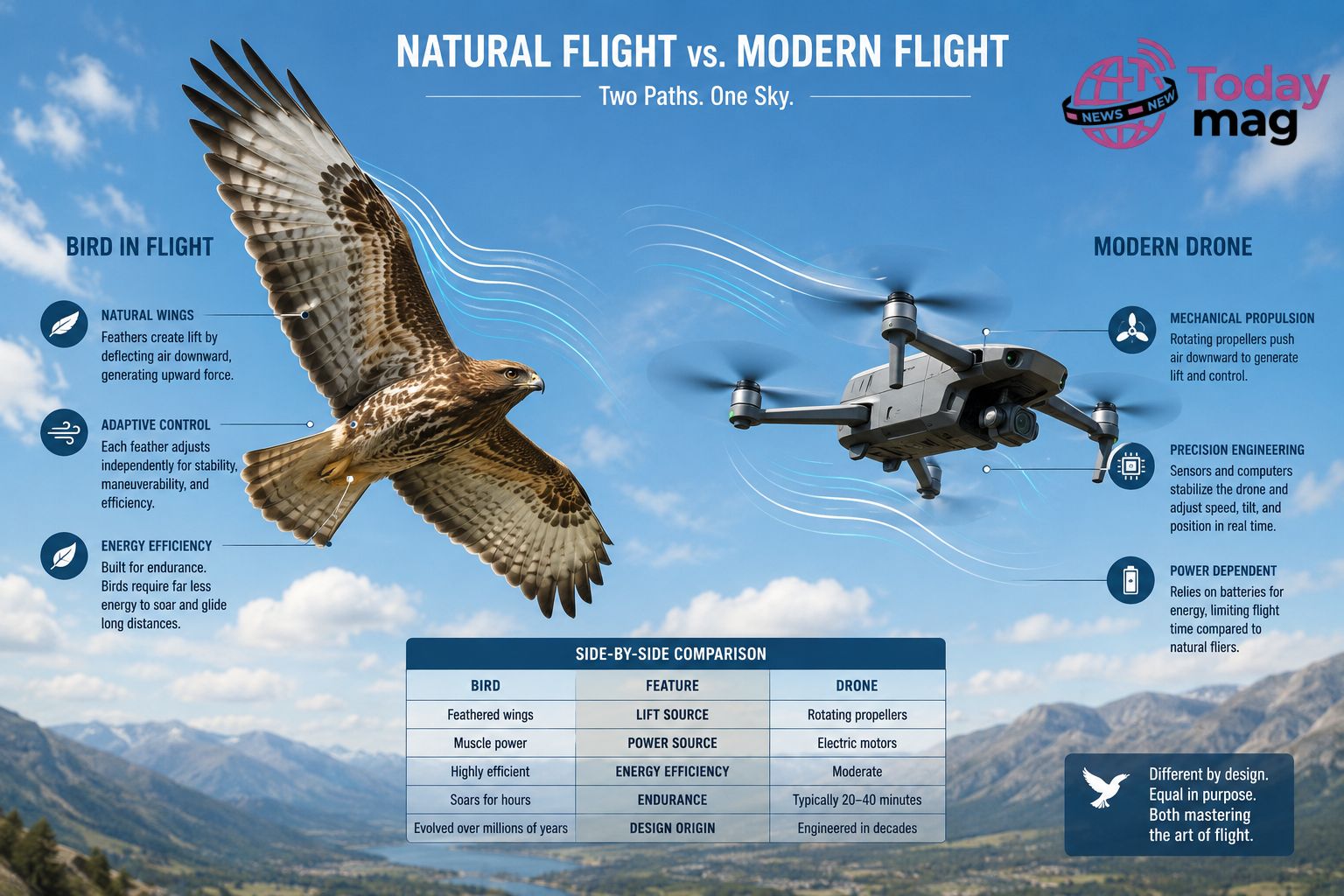
Flight is one of the most complex abilities found in nature. Birds achieve it through biological systems that have evolved over millions of years. Flying robots, on the other hand, rely on mechanical components, software, and energy systems developed by human engineers.
Birds fly using muscles, lightweight bones, feathers, and highly specialized wings. Every part of their body contributes to efficient movement through the air. Their flight abilities are deeply connected to survival, helping them find food, escape predators, and migrate across continents.
Robots fly through motors, propellers, sensors, batteries, and advanced control algorithms. Unlike birds, they do not evolve naturally. Instead, engineers design and refine them to achieve specific goals such as surveillance, mapping, or transportation.
Both systems achieve the same outcome flight but through entirely different approaches.
The Evolution of Flying Birds
Bird flight is the result of one of nature’s most remarkable evolutionary journeys. Scientists believe modern birds evolved from feathered dinosaurs more than 150 million years ago. Over time, natural selection favored lighter bodies, stronger flight muscles, and improved wing structures.
This long evolutionary process produced birds capable of extraordinary feats. Some species migrate thousands of kilometers every year, crossing oceans and deserts with incredible accuracy. Others perform complex aerial maneuvers while hunting insects or avoiding predators.
Birds have adapted to nearly every environment on Earth. From tropical rainforests to Arctic regions, they demonstrate a level of versatility that few other flying creatures can match.
Their success comes from continuous adaptation. Every feather, bone, and muscle serves a purpose in maximizing flight performance while minimizing energy consumption.
The Rise of Flying Robots
The history of robotic flight is much shorter but equally fascinating. Early aviation pioneers studied birds extensively while developing the first flying machines. Their observations influenced aircraft wing designs and aerodynamic principles.
In recent decades, advances in electronics, materials science, and artificial intelligence have transformed flying robots into highly capable machines. Modern drones can operate autonomously, collect data, and perform precise maneuvers in environments that may be dangerous for humans.
Flying robots now serve industries ranging from agriculture and construction to emergency response and scientific research. Their rapid development demonstrates how engineering can solve complex challenges by combining mechanics, software, and automation.
Unlike birds, robots can be redesigned quickly. Engineers can modify their shape, sensors, and capabilities without waiting for generations of evolutionary change.
Flight Mechanics Compared
One of the biggest differences between birds and robots lies in how they generate lift and control movement.
Bird wings are incredibly sophisticated structures. Feathers can adjust position during flight, allowing birds to respond instantly to changing wind conditions. Their wings flex naturally, providing exceptional control and efficiency.
Most flying robots rely on fixed wings or rotating propellers. While these systems are effective, they often lack the flexibility of biological wings. Engineers compensate through sensors and computerized flight controls that continuously adjust motor speeds and flight paths.
Birds excel in complex environments such as forests, where quick reactions and precise maneuvering are essential. Many species can change direction almost instantly while avoiding obstacles.
Robots perform exceptionally well in predictable conditions. Their navigation systems allow them to follow programmed routes with remarkable accuracy, making them ideal for inspections, mapping, and surveying tasks.
Each approach has distinct advantages depending on the situation.
Speed, Agility, and Control
When comparing flight performance, both birds and robots have impressive capabilities.
Some birds achieve extraordinary speeds. The peregrine falcon, for example, can exceed 300 kilometers per hour during hunting dives. Many seabirds travel long distances while maintaining efficient cruising speeds.
Bird agility is equally impressive. Their ability to twist, turn, and react to changing conditions remains difficult for machines to replicate fully.
Robots, however, offer unmatched precision. Modern drones can hover steadily, maintain exact positions, and execute programmed maneuvers repeatedly with minimal variation. Advanced stabilization systems help them operate effectively even when carrying cameras or specialized equipment.
While birds often outperform robots in natural agility, robots excel in repeatable precision and controlled operations.
Intelligence in the Air
Flight is not solely about physical ability. Intelligence plays a crucial role in navigation, decision-making, and adaptation.
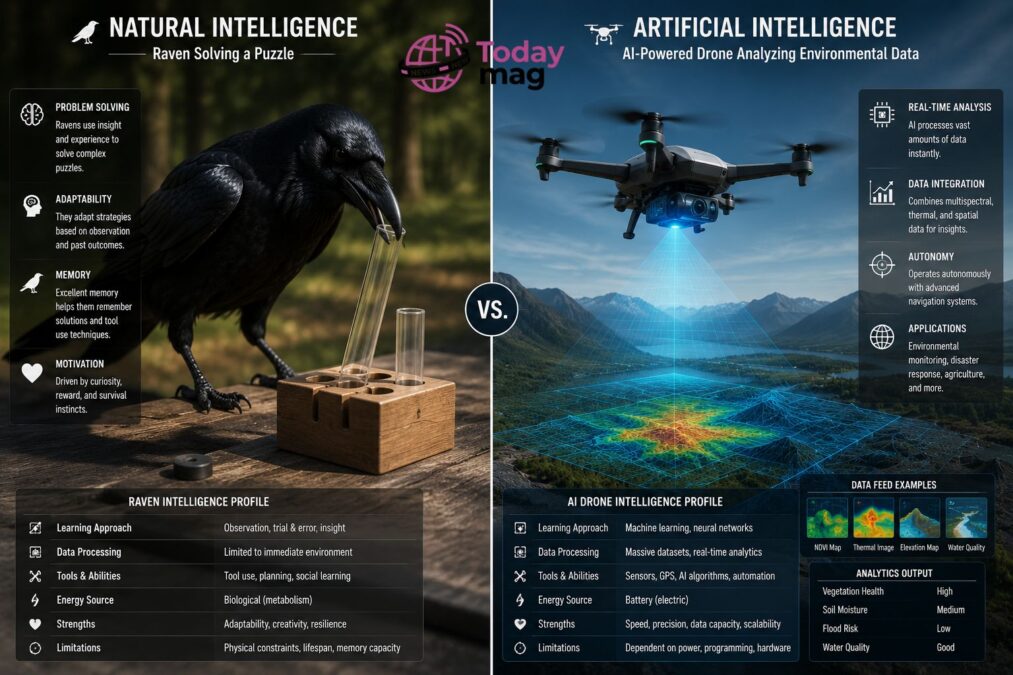
Birds possess remarkable cognitive skills. Research has shown that many species can solve problems, use tools, recognize patterns, and remember locations. Migratory birds navigate using a combination of environmental cues, magnetic fields, and celestial references.
Their intelligence evolved naturally to support survival and reproduction.
Robots rely on artificial intelligence and machine learning systems. These technologies allow machines to process large amounts of information, identify objects, avoid obstacles, and make autonomous decisions.
Unlike birds, robots can instantly share information across networks. Multiple drones can coordinate operations and work together as a team. However, their intelligence remains dependent on software and available data.
Bird intelligence is flexible and adaptive, while robotic intelligence is computational and task-oriented.
Energy and Endurance Battle
Energy efficiency is one area where birds continue to impress scientists.
Birds convert food into fuel through highly efficient biological processes. Their bodies are optimized for long-distance travel, and many species can fly for hours or even days with minimal rest.
Some migratory birds undertake journeys spanning thousands of kilometers without stopping. Their endurance demonstrates an extraordinary balance between energy storage and consumption.
Flying robots face greater challenges. Most drones depend on batteries that limit flight duration. Although battery technology continues to improve, many commercial drones remain airborne for less than an hour before requiring recharging.
Engineers are exploring alternatives such as solar power, hydrogen fuel cells, and hybrid energy systems. These technologies may significantly extend robotic flight endurance in the future.
For now, birds maintain a clear advantage in long-term energy efficiency.
Adaptability to Different Environments
Birds have evolved to thrive in diverse habitats. Eagles soar over mountains, seabirds navigate storms, and hummingbirds hover among flowers. Their adaptability comes from millions of years of environmental specialization.
Flying robots approach adaptability differently. Engineers customize them for specific missions and operating conditions. Some are designed for indoor inspections, while others operate in deserts, forests, or disaster zones.
Robots can enter dangerous environments where human access is difficult or risky. They are used to inspect damaged buildings, monitor wildfires, and explore hazardous locations.
While birds naturally adapt to ecosystems, robots achieve adaptability through design and programming.
Design Excellence: Evolution vs Engineering
The design comparison between birds and robots highlights two fundamentally different processes.
Birds are products of natural evolution. Their bodies represent countless generations of refinement, where successful traits were preserved and improved over time. This has produced lightweight structures, efficient respiratory systems, and highly optimized flight mechanisms.
Robots result from deliberate engineering decisions. Designers can focus on specific goals without biological limitations. A drone intended for aerial photography can prioritize stability, while one designed for racing can emphasize speed.
Birds demonstrate the power of evolutionary optimization. Robots demonstrate the flexibility of human creativity and innovation.
Neither approach is inherently superior; each reflects a different path toward achieving flight.
Real-World Applications
Birds play essential roles in maintaining healthy ecosystems. They pollinate plants, disperse seeds, control insect populations, and contribute to ecological balance. Their activities support biodiversity and environmental stability worldwide.
Flying robots provide valuable services for human society. They assist in agriculture by monitoring crops, help emergency responders locate survivors, and support infrastructure inspections that would otherwise require significant time and resources.
In environmental research, drones collect data from remote regions and help scientists monitor wildlife populations. These capabilities complement rather than replace the natural contributions of birds.
Both birds and robots provide unique benefits that extend beyond flight itself.
Bird-Inspired Robotics
Nature continues to inspire technological innovation. Engineers frequently study birds to improve robotic flight systems through a field known as biomimicry.
Bird-inspired robots attempt to replicate the flexibility and efficiency of natural wings. Some use flapping mechanisms instead of traditional propellers, allowing more bird-like movement. Others incorporate lightweight materials and advanced sensors based on biological structures.
These designs aim to combine the adaptability of birds with the precision of machines.
Although current robotic birds remain limited compared to their natural counterparts, ongoing research continues to narrow the gap between biological and artificial flight systems.
The Ultimate Comparison
When comparing birds and robots directly, the outcome depends on the criteria being evaluated.
Birds dominate in natural efficiency, endurance, adaptability, and self-sufficiency. They require no external maintenance, recharge through feeding, and continuously adapt to environmental changes.
Robots excel in customization, precision, data collection, and specialized tasks. They can carry advanced equipment, operate in dangerous locations, and perform missions beyond the capabilities of most birds.
Birds represent the pinnacle of natural flight. Robots represent the forefront of technological flight.
Rather than competitors, they can be viewed as complementary solutions serving different purposes.
Future of Flight
The future of aerial technology will likely involve even greater collaboration between biology and engineering. Researchers continue to study birds to uncover new insights into aerodynamics, energy efficiency, and navigation.
Advances in artificial intelligence, materials science, and energy storage may enable robots to achieve levels of agility and endurance previously considered impossible. At the same time, birds will remain invaluable models for understanding how efficient flight can be achieved naturally.
Future flying machines may combine the best aspects of both worlds borrowing nature’s wisdom while leveraging human innovation.
The lessons hidden within bird flight continue to inspire breakthroughs that could shape the next generation of aerial technology.
Frequently Asked Questions (FAQs)
Are birds better flyers than robots?
In terms of natural efficiency, endurance, and adaptability, birds are generally better flyers. Robots, however, excel in precision, data collection, and specialized missions.
Why do engineers study birds when designing robots?
Birds provide valuable insights into aerodynamics, wing movement, energy efficiency, and navigation. Many robotic flight systems are inspired by these natural abilities.
Can robots fly as long as migratory birds?
Most current flying robots cannot match the endurance of migratory birds. Battery limitations remain one of the biggest challenges in robotic flight.
What are bird-inspired robots?
Bird-inspired robots are flying machines designed to mimic the movement and structure of birds. They often use flapping wings and lightweight materials to improve flight performance.
Will robots eventually fly exactly like birds?
Researchers are making significant progress, but replicating the flexibility, efficiency, and adaptability of birds remains a complex challenge. Future technologies may come much closer.
Conclusion
The debate surrounding birds vs robots reveals a fascinating contrast between evolution and engineering. Birds embody millions of years of natural refinement, delivering unmatched efficiency, adaptability, and endurance. Robots showcase humanity’s ingenuity, offering precision, customization, and advanced technological capabilities.
Neither side completely outperforms the other because they were created for different purposes. Birds are masters of natural survival and ecological balance, while robots are tools designed to solve human challenges.
Together, they demonstrate the incredible possibilities of flight. One represents nature’s masterpiece, and the other represents human innovation. As technology continues to evolve, the inspiration drawn from birds will remain central to the future of robotic flight, ensuring that this ultimate battle of flight and design continues to drive discovery and progress.
